
Updated 2026 • Dog Carrier Comparison Guide
Finding the right dog carrier for your pup isn't always as easy as it sounds. We (Steph and Mike) know from experience.
Our longhaired dachshund, Django, has lived with us in New York City, Portland (Oregon), San Diego, Philadelphia, and the New Jersey suburbs—and each place has brought a completely different lifestyle. In New York, we carried Django through subway stations, along busy sidewalks, and into dog-friendly shops. In Oregon, weekends typically meant hiking up steep trails and camping. In Southern California, we were constantly exploring new beachside trails.
After more than a decade of traveling with (and carrying!) Django, two pet carrier styles have become our go-to choices for most everyday adventures: dog carrier tote bags and dog backpack carriers. Both can be incredibly useful, but they solve very different problems.
A dog carrier tote bag keeps your dog right beside you and is often ideal for errands, city outings, vet visits, pet-friendly public transportation, and quick trips. A backpack keeps your hands free and distributes your dog's weight across both shoulders, making it a better choice for hiking, sightseeing, long walks, stairs, and full days on the go.
If you're still deciding among totes, backpacks, airline-friendly carriers, slings, and travel crates, start with our guide to the different types of dog carriers.
If you've already narrowed your search to a tote or backpack, you're in the right place.
Below, we'll compare the two styles side by side—including comfort, accessibility, weight distribution, support, storage, hiking, everyday use, and the situations where each carrier style works best—so you can confidently choose the right one for you and your dog.
Dog Carrier Tote or Backpack: Which Is Better?
You want your dog right beside you for errands, public transportation, vet visits, shopping, hotels, city commutes, and shorter everyday outings.
You want both hands free and/or regularly hike, sightsee, climb stairs, walk longer distances, navigate crowds, or carry your dog for extended periods.
Your dog stays beside you, making it easy to see them, check on them, offer reassurance, or take them in and out when appropriate.
A properly fitted backpack spreads your dog's weight across both shoulders; a sternum strap and supportive hip belt can improve stability and carrying comfort.
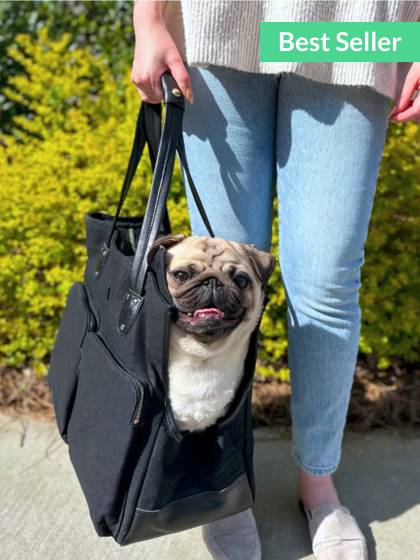
Want to see what these styles look like? Explore the DjangoTote™ for everyday outings and the DjangoPack™ for longer, hands-free adventures.
Do a little of everything? For small-dog parents who regularly do both city errands and longer adventures, owning both can make sense. Otherwise, choose the style that best matches your most frequent outings.
Dog carrier tote bags
Dog backpack carriers
Tote vs. backpack comparison
Which is better for different outings?
Does it make sense to own both?
DjangoTote™ vs. DjangoPack™
What about flying?
FAQ
What Is a Dog Carrier Tote Bag?
A dog carrier tote is a shoulder-carried pet bag (or pet purse) designed to keep a small dog close to your side.
Some look like traditional pet carriers. Others are designed more like premium handbags or weekender totes, with supportive pet-friendly features built into a polished everyday bag. We're partial to the latter.

Why Choose a Dog Carrier Tote?
Your dog stays right beside you. You can glance down and see what they're doing, check on them easily, pet them, and notice quickly if they seem restless.
They're extremely convenient for everyday life. A pet carrier tote is easy to grab, carry into an appointment, bring through a hotel lobby, or throw over your shoulder for an errand.
Access is easy. In an open-front tote, a calm, securely tethered dog can watch the world go by while staying close to you.
A well-designed tote with secure storage can replace your everyday bag. Secure storage for your phone, wallet, keys, treats, waste bags, and other essentials means one less thing to carry.
They can be discreet and stylish. Many people prefer a carrier that looks more like a polished tote or weekender than traditional pet gear.
- Keeps your dog directly beside you
- Easy to visually monitor your dog
- Quick access for appropriate outings
- Can provide useful storage for both human and dog essentials
- Often more stylish and discreet than a backpack carrier
- A structured, sturdy base can provide stable support beneath your dog—particularly valuable for long-backed breeds like dachshunds
- Most of your dog's weight sits on one shoulder
- Can become tiring during longer walks or with heavier dogs
- Does not keep both hands completely free
- Open-front styles are not right for every dog's temperament
- Less practical than a backpack for hiking and highly active outings
- Open-front everyday totes generally are not suitable for under-seat airline travel
If you're considering a dog carrier tote, construction and support matter just as much as style. Our detailed guide to dog carrier tote safety explains what to look for in the base, airflow, safety tether, handles, materials, and overall construction.
And if you're comparing individual tote designs, see our guide to choosing the best dog carrier tote bag for a small dog.
What Is a Dog Backpack Carrier?
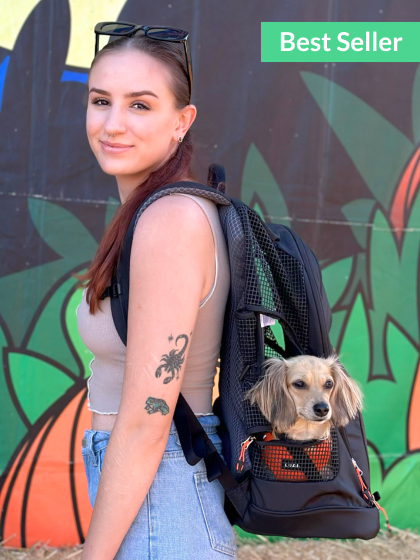
A dog backpack carrier lets you carry your dog on your back using two shoulder straps, much like a traditional backpack.
The best dog backpack carriers go further than simply adding shoulder straps to a pet bag. A good hiking or travel backpack should distribute carrying weight comfortably, support your dog from underneath, provide ample ventilation, and stay stable as you move.

Why Choose a Dog Backpack Carrier?
Your hands stay free. This matters on trails, stairs, busy sidewalks, travel days, or anytime you're also carrying luggage, holding a child's hand, checking your phone, or juggling everything else life throws at you.
Your dog's weight is distributed more evenly. A backpack spreads the load across both shoulders instead of concentrating everything on one side. More supportive designs include a sternum strap and properly fitted hip belt that can improve stability and help shift some weight toward your hips.
They're better for distance. If we know we're going to be carrying Django for a meaningful stretch of time, we'll always reach for our dog backpack carrier.
They're especially useful for active outings. Hiking is the obvious example, but backpacks are also great for sightseeing, city days, stairs, train stations, crowded environments, and outings where a small or senior dog will eventually need a lift.
- Keeps both hands free
- Distributes your dog's weight across both shoulders
- Better suited to longer carrying distances
- Excellent for hiking, sightseeing, stairs, and active outings
- Sternum straps and hip belts can improve stability and comfort
- Fully enclosed designs provide greater containment
- Quality designs can offer excellent ventilation and storage
- A horizontal design can support your dog naturally from underneath
- Your dog rides behind you, so you cannot watch them continuously
- Less convenient for quickly checking on or accessing your dog
- Usually bulkier than an everyday tote
- Can feel excessive for very short errands
- Quality and dog positioning vary significantly among designs
- Some backpack-style carriers offer minimal human support despite having two shoulder straps
One Important Difference: Your Dog Is Behind You
This may sound obvious, but it's worth considering.
In our dog carrier tote bag, Django is always right beside us. We can glance down and immediately see what he's doing or give him a quick pat on the head.
In our backpack carrier, Django rides behind us and is largely out of view. We don't have the same continuous visual contact, so we stop regularly to check on him.
For a calm, carrier-trained dog, riding out of direct view may be perfectly comfortable. But if your dog is anxious, needs frequent reassurance, or is still getting used to carrier travel, you may appreciate the visibility and easy access of a tote. Whichever style you choose, introduce it gradually with positive carrier training.
Horizontal vs. Upright Backpack Carriers
Dog backpack carriers also position dogs differently. Some hold dogs upright or vertically. Others, including our DjangoPack™, have a sturdy horizontal floor so the dog is supported from underneath and can naturally stand, sit, curl up, or lie down.
As dachshund parents who have seen Django through temporary paralysis of his back legs, Stage 4 IVDD surgery, and a months-long recovery, we take full-body support seriously. We choose carriers with a stable surface beneath him rather than a design that holds his body in a fixed upright position.
In our interview with dachshund hiking educator Jessica Williams, she also emphasized choosing a backpack that lets a dog ride horizontally or in a natural position with all four paws supported. For a deeper look at backpack positioning, floor support, ventilation, security, and fit, see our guide to dog backpack carrier safety.
Dog Carrier Tote vs. Backpack: Side-by-Side Comparison
If you're deciding between the two, this is the comparison that matters most.
| Feature | Dog Carrier Tote | Dog Backpack Carrier |
|---|---|---|
| Best for | Errands, vet visits, shopping, hotels, commuting and public transportation, shorter everyday outings | Hiking, sightseeing, longer walks, stairs, active travel, hands-free outings |
| Carrying style | Over one shoulder or by hand | Across both shoulders; supportive designs may also use sternum and hip straps |
| Dog accessibility | Excellent; your dog stays directly beside you | Lower; your dog rides behind you |
| Visual contact | Very easy to monitor your dog | Requires turning or stopping to visually check your dog |
| Hands-free | Not completely | Yes |
| Long-distance carrying | Better for shorter carries | Much better for long-distance carrying, assuming the carrier is properly designed and distributes weight correctly |
| Weight distribution | Primarily one shoulder | Across both shoulders; a properly fitted hip belt and sternum strap may improve stability and carrying comfort |
| Everyday convenience | Excellent | Good, but generally bulkier |
| Hiking & active outings | Not our first choice | Excellent when properly designed |
| Storage | Can replace an everyday purse or tote when designed with useful pockets | Varies; quality designs can offer substantial technical storage |
| Overall style | Varies. High-quality designs often resemble a premium purse or weekender bag | Varies, but premium products typically are technical and/or adventure-focused |
| Best choice for heavier small dogs | Can work well for short carries when correctly sized and rated for the dog | Often more comfortable over distance because the weight is distributed across both shoulders |
Two Carriers. Two Very Different Jobs.
For everyday outings, easy access, and a stylish weekender-style bag you'll actually love on your arm, shop the DjangoTote™ Dog Carrier Bag For hiking, sightseeing, longer carrying, and hands-free adventures, shop the DjangoPack™ Dog Carrier Backpack.
Shop Tote Carriers Shop Backpack CarriersWhich Is Better for Your Dog and Lifestyle?
There isn't one winner for every dog. The better carrier depends on where you're going, how long you'll carry your pup, your dog's temperament, and their size and weight.
A dog carrier tote bag wins for convenience. Throw it over your shoulder, keep your dog beside you, stash your essentials in the pockets, and go.
Easy access and close contact make a dog carrier tote bag convenient when you're moving between the car, sidewalk, waiting room, and exam room.
A dog carrier tote bag is excellent for shorter commutes and easy access. A dog carrier backpack becomes more appealing when you're walking farther, climbing lots of stairs, or need both hands free.
A supportive backpack is generally the more practical choice on trails. Weight distribution, stability, hands-free carrying, and a proper backpack harness system matter here.
If you'll be on your feet for hours, spreading your dog's weight across both shoulders is considerably more comfortable than carrying everything on one side.
A stylish and discreet dog carrier tote tends to feel much more natural in everyday settings and can double as your regular bag.
A dog carrier tote works beautifully for shorter lifts and easy access. If your senior pup needs to be carried farther, a supportive backpack can be significantly easier on you.
The heavier your dog gets, the more valuable two-shoulder weight distribution becomes—especially when you're carrying them for more than a short distance.
If your dog takes comfort from seeing and feeling you nearby, having them directly beside you may be preferable to carrying them behind you.
When your hands are already occupied, a dog carrier backpack can make getting through stations, sidewalks, hotels, and crowds considerably easier.
A properly fitted backpack can make longer carries more comfortable by distributing weight across both shoulders, but lifting it onto your back and maintaining balance must also feel manageable. A lighter tote may be easier for short trips. Choose what feels secure and comfortable for you.
Does It Make Sense to Own Both a Tote and Backpack?
Absolutely—if your dog regularly joins you for different kinds of outings where each carrier has a distinct purpose. Here's why we use both.
We lived in New York City for more than a decade, and I (Steph) still visit often. For city days, I love bringing Django in his waxed canvas dog carrier tote. It’s stylish enough to carry everywhere, easy to keep right by my side, and practical enough to hold my everyday essentials—phone, wallet, keys, dog treats, and waste bags.
Our family adventures, on the other hand, look completely different.
We do a lot of local trails and family trips with our kids and Django. When we head to places like the Poconos, upstate New York, or New England in the fall, we bring Django’s hiking-friendly dog backpack carrier.
Our seven-year-old has seemingly endless energy, but Django’s little legs get tired much sooner these days. His backpack gives him a supportive, comfortable place to rest when he needs a break. Meanwhile, our hands are free to hold the kids’ hands, carry gear, and enjoy the outing together.
For our family, owning both makes sense. But if your dog mostly joins you for one type of outing, starting with the carrier you’ll use most often is a great choice.

DjangoTote™ vs. DjangoPack™
We designed the DjangoTote™ Dog Carrier Tote and DjangoPack™ Dog Carrier Backpack for very different kinds of outings.
But our priorities are the same in both: proper support for the dog, high-quality construction, secure details, thoughtful storage, and a carrier that's genuinely comfortable and useful for the person carrying it.
| Feature | DjangoTote™ | DjangoPack™ |
|---|---|---|
| Best for | Everyday outings, errands, vet visits, hotels, city life | Hiking, sightseeing, longer walks, travel, hands-free adventures |
| Dog position | Horizontal support on a firm and cozy tote floor | Horizontal support on a 14" × 10" quilted base |
| Access | Open front scoop for easy visibility and access | Fully enclosed with one secure zipper opening for entry and exit and two roll-back side windows for visibility, head room, and ventilation |
| Ventilation | Open scoop and open top | Large wide-grid mesh panels and roll-back side windows |
| Security | Adjustable bag-to-harness safety tether | YKK® locking zippers plus adjustable backpack-to-harness tether |
| Human carrying system | Genuine leather shoulder handles internally reinforced with strong webbing | Padded shoulder straps, sternum strap, removable hip belt, padded back panel |
| Primary material | Premium 20 oz. waxed cotton canvas and genuine leather | Durable recycled polyester with water-repellent protection and technical backpack construction |
| Storage | Four secure zipper pockets plus organization for everyday essentials | Zippered storage, water bottle pocket, laptop sleeve, and additional carrying features |
| Overall feel | Premium everyday tote and weekender bag | Supportive adventure and travel backpack |
Which DJANGO Carrier Will Fit Your Dog?
Carrier style is only part of the decision. Before buying, measure your dog’s back length and standing height, check their weight, and compare those measurements with the usable space inside the carrier. Long-backed dogs, including dachshunds, may need a larger bag than their weight suggests.
- Medium DjangoTote: 14.5" L × 8" W × 12.5" H; generally best for petite dogs up to approximately 10–12 lbs.
- Large DjangoTote: 17.5" L × 8" W × 14.5" H; generally best for small dogs up to approximately 20–25 lbs, depending on measurements.
- DjangoPack: 14" × 10" structured base and 18.5" carrier height; designed for small dogs up to approximately 20–25 lbs, depending on back length, height, and build.
Those are starting points, not guaranteed fits. Use our step-by-step dog carrier measuring guide, then check the sizing information on each product page before ordering.
DjangoTote™ Dog Carrier Bag: For Everyday Carry
The DjangoTote safely and comfortably carries small dogs while offering the function, quality, storage, and understated style of a premium everyday tote.
A firm structured base supports your pup from underneath. A removable sherpa-lined footpad adds softness. The open front scoop provides easy visibility and airflow. An adjustable bag-to-harness tether adds security. And premium waxed canvas, genuine leather, reinforced handles, and four zipper pockets make it a bag you'll actually want on your arm.
Shop the DjangoTote™
DjangoPack™: Supportive Carry for Hands-Free Adventures
The DjangoPack is engineered like a top-tier hiking backpack with a secure and comfortable riding space for your dog.
Your dog rides on a fully supportive horizontal base with large wide-grid mesh panels for airflow, premium YKK® locking zippers for secure closure, and an interior harness tether for added security. For you, padded shoulder straps, a breathable padded back panel, adjustable sternum strap, and removable hip belt help distribute and stabilize your dog's weight.
Shop the DjangoPack™
At DJANGO, we know our pet carriers inside and out. We also know how different breeds, body shapes, and weights tend to fit in each design. Send us your dog's breed, weight, back length, standing height, and (if possible) a side-view photo, and we'll help you decide between styles and sizes.
Email us at hello@djangobrand.com.
What About Flying With Your Dog?
An everyday dog carrier tote or hiking backpack should not automatically double as an airplane carrier. In-cabin pet travel generally requires a fully enclosed, well-ventilated carrier that fits beneath the seat and complies with the operating airline’s current rules. Carrier requirements can vary by airline and aircraft.
Neither the DjangoTote nor the DjangoPack is designed or marketed as an under-seat airline carrier. If flying is your main priority, see the airline-friendly carrier section of our complete dog carrier guide, and verify current requirements with your airline before booking.
Helpful Dog Carrier Guides
- 5 Types of Dog Carriers: Which Is Best for Your Dog?
- How to Measure Your Dog for a Pet Carrier: Tote, Backpack & Airline Bag Size Guide
- Are Dog Carrier Tote Bags Safe? What to Look For in a Supportive Pet Carrier
- Best Dog Carrier Tote Bag for Small Dogs: What to Look For
- How to Choose a Dog Backpack Carrier: Size, Safety & Fit
- Are Dog Backpack Carriers Safe?
- How to Train Your Dog to Love Riding in a Pet Travel Carrier
- Dachshund Hiking, Enrichment & Backpack Carrier Advice: An Expert Interview
- Dog Mobility, IVDD & Safer Adventures: A Veterinary Surgeon Interview
Dog Carrier Tote vs. Backpack FAQs
Is a dog carrier tote or backpack better? +
Neither is better for every situation. A dog carrier tote is generally more convenient for quick errands and outings, city travel, vet visits, shopping, hotels, commuting, and shorter everyday outings because your dog stays directly beside you and is easy to access. A dog backpack carrier is usually better for hiking, sightseeing, longer walks, stairs, and hands-free carrying because it distributes your dog's weight across both shoulders.
Are dog backpack carriers easier to carry than tote carriers? +
For longer distances, yes. A tote places most of your dog's weight on one shoulder, while a backpack distributes the load across both shoulders. Well-designed pet backpack carriers will also include a sternum strap and hip belt to improve stability and weight distribution. For short outings, however, many people find a tote quicker and easier to grab.
Are dog carrier totes comfortable for dogs? +
A well-designed dog carrier tote can be very comfortable when it fits the dog properly. Look for a firm, level base that supports the dog's body, enough usable floor space for their proportions, soft cushioning, good airflow, and an appropriate safety tether. Avoid tote bags that sag deeply beneath the dog's weight or leave them struggling to find stable footing.
Is a tote or backpack better for a dachshund? +
Either can work well when it provides enough usable space and a firm horizontal surface underneath the dog. For everyday outings, we like a supportive dog carrier tote that keeps the dachshund's body stable from front to back. For longer carrying and hiking, we prefer a horizontal backpack carrier that supports the dog from underneath rather than holding the body in a fixed upright position. If your dachshund has IVDD, current back pain, a recent spinal injury, or another orthopedic condition, please consult your veterinarian or neurologist before using any pet carrier.
Which carrier is better for a senior dog? +
It depends on how far you will carry your dog. A supportive tote can be excellent for shorter outings because your dog stays close and is easy to access. If your senior dog needs to be carried farther, a well-designed backpack can be considerably easier for the human because the dog's weight is distributed across both shoulders.
Is a dog carrier tote or backpack better for the vet? +
For many small dogs, we prefer a tote for vet visits because it is easy to carry from the car or sidewalk into the clinic, keeps the dog directly beside you, and allows quick access when appropriate. A backpack can be useful if you have a longer walk to the clinic, need both hands free, or find one-shoulder carrying uncomfortable.
Is a dog backpack carrier better for hiking? +
Yes, a properly designed backpack carrier is generally much better suited to hiking than a shoulder tote. Look for a stable base beneath the dog, excellent ventilation, secure closures, padded shoulder straps, a sternum strap, a supportive hip belt, and a balanced carrying system designed to handle your dog's weight comfortably.
Which is better for a heavier small dog: a tote or backpack? +
For longer carrying, a supportive backpack is generally more comfortable because it distributes your dog's weight across both shoulders rather than concentrating the load on one side. A properly rated tote can still work very well for shorter outings with a heavier small dog.
Can a dog carrier tote or backpack be used on an airplane? +
Not automatically. Airlines generally require in-cabin pets to remain fully enclosed inside an appropriate carrier that fits beneath the airplane seat. Open-front everyday totes are therefore generally not suitable as under-seat airline carriers. Some enclosed backpack-style carriers may meet certain airline requirements, but the DjangoPack and DjangoTote are not designed for under-seat airline travel. Always compare any flight carrier's dimensions and design with your operating airline's current pet policy before traveling.
Should a dog carrier have a firm bottom? +
We strongly prefer a firm, stable base in both dog carrier totes and backpack carriers. The floor should remain supportive beneath your dog's weight rather than sagging deeply into a hammock shape. Soft cushioning can sit on top of the structured base for comfort.
How do I know what size dog carrier to buy? +
Do not rely on weight alone. Measure your dog's back length, overall standing height, body width, and weight, then consider body shape and preferred riding position. Compare those measurements with the carrier's usable dimensions and the manufacturer's sizing guidance. Our pet carrier sizing guide explains how to take each measurement correctly.
Do I need both a dog carrier tote and a backpack? +
Not every dog parent needs both, but the combination can be extremely useful if your dog regularly joins you for different types of outings. Use a tote for errands, cafés, vet visits, hotels, and shorter everyday trips. Use a backpack for hiking, sightseeing, longer walks, stairs, and hands-free carrying. Each style does a different job particularly well.
Ready to Find the Right Carrier for Your Dog?
Start with the outings you take most often, then confirm your dog's measurements and fit. Whether you choose the everyday convenience of a tote or the hands-free comfort of a backpack, the right carrier should make adventures more enjoyable for both of you.
Explore the DjangoTote™ Explore the DjangoPack™