



Updated March 2026
If you have a dachshund, intervertebral disc disease (IVDD) is something worth understanding early. We know from first-hand experience.
In 2022, our longhaired dachshund suddenly became paralyzed in his hind legs and needed emergency Stage 4 IVDD surgery. It was one of the most traumatic experiences we’ve had as dog owners. His recovery was slow and difficult for both him and us, but thankfully, he made a full recovery with surgery and is back to running, playing, and enjoying life today. He turned 10 last August!
Intervertebral disc disease is one of the most common and most serious health conditions affecting dachshunds and other long-backed breeds, and it can feel overwhelming when you first start researching it.
In this guide, we’ll walk through the basics of IVDD in dogs, the warning signs to watch for, how to help reduce your dog’s risk, treatment options, recovery, and realistic IVDD surgery costs.
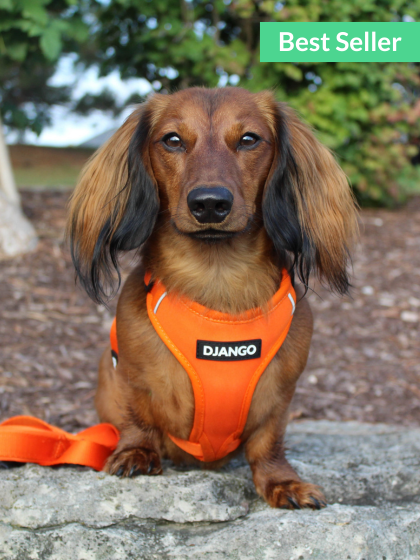
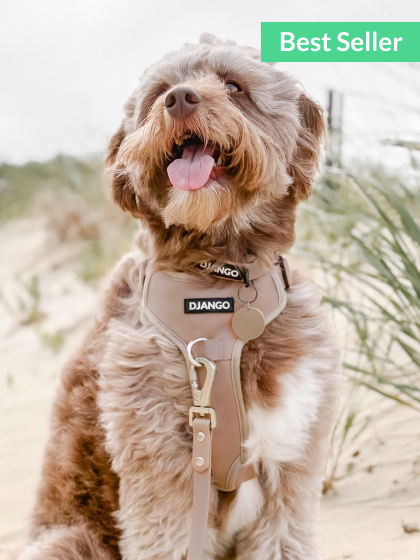
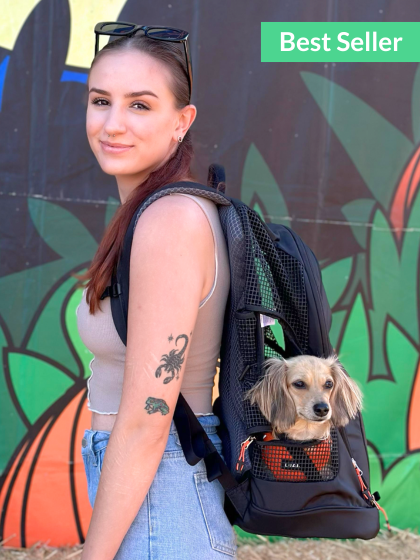
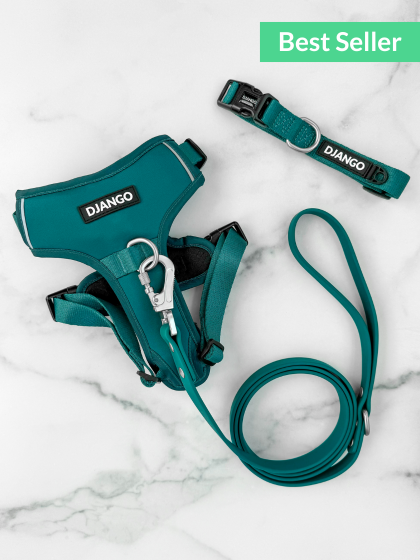
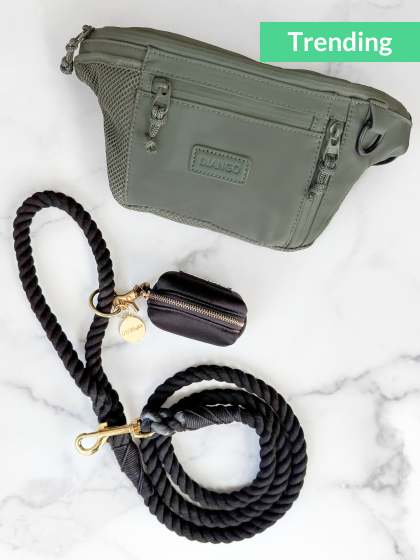
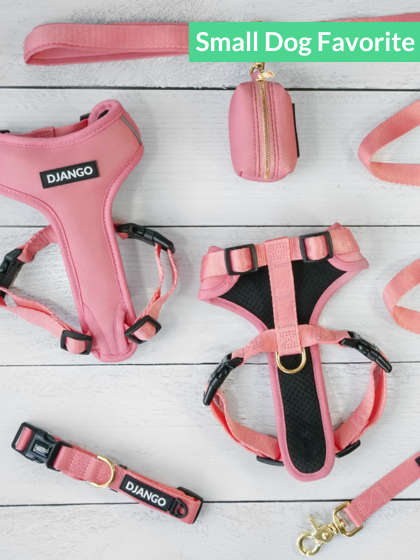
We’ll also share helpful DJANGO resources for dachshund owners, including IVDD-friendly harnesses, supportive dog carrier backpacks, and prevention-related articles that may support safer everyday movement and outings.
- Dachshunds are one of the dog breeds most at risk for IVDD, especially between ages 3 and 6.
- Early warning signs can include wobbling, reluctance to jump, pain, weakness, and changes in mobility.
- Acting quickly matters. If you suspect IVDD, call your vet immediately.
- IVDD surgery costs can add up quickly once MRI, hospitalization, medication, and aftercare are included.
- Supportive daily habits like limiting jumping, maintaining a healthy weight, and choosing the right walking gear may help reduce strain on your dog’s back.
What is IVDD in dogs?
What causes intervertebral disc disease in dogs?
How to help reduce your dog’s risk of IVDD
Signs and symptoms of IVDD in dogs
What to do if you think your dog has IVDD
Treatment options for IVDD in dogs
What does IVDD surgery cost?
Helpful products for dogs at risk of IVDD
Related DJANGO articles for dachshund owners
FAQ
Additional resources
What is IVDD in dogs?
Intervertebral disc disease (IVDD) is a condition where intervertebral discs between a dog’s spinal vertebrae bulge or burst. Bulging or bursting intervertebral discs can enter the spinal cord space and put pressure on spinal nerves. This can cause wobbling and incoordination, pain, nerve damage, and even lower body paralysis.
If all of this feels overwhelming at first, don’t worry — it did to us too.
Let’s Start with the Basics: Understanding IVDD and Your Dog’s Spine
The spine is made up of individual vertebrae bones.
Dogs have 30 vertebrae running from the neck to the tailbone. Every pup has 7 cervical vertebrae (neck), 13 thoracic vertebrae (chest), 7 lumbar vertebrae (lower back), and 3 sacral vertebrae (pelvic).

The vertebrae between the neck (cervical) and the lower back (lumbar) have soft cushions between them called intervertebral discs. Intervertebral discs are made of cartilage and allow the neck, chest, and lower back to bend. They also act as shock absorbers. When a dog jumps off a couch or bed, intervertebral discs are cushioning the fall—they are preventing the dog’s spinal vertebrae bones from touching or banging together.
The spinal cord, which is made up of spinal nerves, runs through the vertebrae.

There are two types of intervertebral disc disease:
Type 1 disc disease
Type 1 intervertebral disc disease, also known as a “slipped disc”, occurs when the middle part of the intervertebral disc (nucleus pulposus) breaches the outer part of the disc (annulus fibrosis) and enters the spinal cord space. The “slipped disc” can occur on any part of the spine, but a majority of cases target the middle of the back.
Small- and medium-sized dogs are most affected by Type 1 disc disease. Unlike Type 2 disc disease which often affects older dogs, Type 1 often affects dogs between the ages of 3 and 6. The condition can be brought on by sudden impact to the spine (i.e. impact from jumping off a bed or sofa) that bursts the intervertebral disc.
Type 2 disc disease
Type 2 disc disease occurs when the outer layer of the intervertebral disc (annulus fibrosis) bulges and enters the spinal cord space. This spinal cord compression can happen slowly over time and may not cause pain right away. Older mid- and large-sized dogs are most affected by Type 2 disc disease.

What causes IVDD in dogs?
Age
All dogs grow more susceptible to back problems as they age, including non-chondrodystrophic breeds. Over time, intervertebral discs can degenerate and/or calcify (harden). This reduces disc and back flexibility and increases the risk of serious injury. Recall that Type 2 IVDD is largely age-related and can happen slowly over time, resulting in few symptoms at first.
Genetics
Certain breeds are more genetically at risk of IVDD due to their skeletal structure. Chondrodystrophic breeds, most known as dogs with short legs and long backs (but not always), are most susceptible to prematurely aged disks. These breeds tend to have bone and cartilage abnormalities and include: dachshunds, bulldogs, basset hounds, beagles, corgis, cocker spaniels, pekingese, shih-tzus and even poodles.
Obesity
Whether chondrodystrophic or not, obesity significantly increases the risk that a dog will develop IVDD or other back problems.
Sudden trauma
Sudden trauma to the back, even jumping off a bed or sofa “wrong”, can cause an already weakened (degenerated or calcified) intervertebral disk to bulge or burst.
How to help reduce your dog's risk of IVDD
While it is important to follow the below steps to help prevent IVDD in your dog, remember that sometimes IVDD unfortunately just happens. With that said, these precautions can absolutely help reduce the likelihood of a disc disorder in your dog:
Limit jumping
So many IVDD cases result from 'normal' day-to-day activity. Several of our doxie friends mentioned their pup suddenly got IVDD after jumping off an arm chair and landing "wrong".
While some dogs are born jumpers, it's best to limit jumping for those dogs that are at increased risk of IVDD (particularly chondrodystrophic breeds, senior dogs, and pups that have already experienced IVDD). Sudden shock to a dog's back, especially from jumping down, will put extra stress on a dog's spine.
Not sure how to limit your dog's jumping? Consider investing in a high quality pet ramp or pet stairs if your dog is able to jump on and off furniture including beds and sofas.
DJANGO Review: The Most Popular Pet Gates, Dog Ramps, & Bedside Stairs
READ THE RAMPS & STAIRS GUIDEMaintain a healthy weight
Whether chondrodystrophic or not, obesity significantly increases the risk that a dog will develop IVDD. Extra weight puts unnecessary strain on the spine and also increases the risk of intervertebral disk calcification.
Good nutrition is key
Strong bones and good muscle tone are incredibly important in the fight against IVDD. A nutritious dog food high in protein (meat should be the first ingredient) will help maintain your dog’s weight and strength and reduce the risk of IVDD.
Harness or collar?
The question of which is better to help reduce strain—a high quality dog harness or a collar—is widely debated. Dogs that already experienced cervical (neck) IVDD would do better in a harness. For other dogs, harnesses may actually encourage pulling, straining and jerking while on a leash. No matter what your dog is wearing, pulling and straining increases the risk of back and neck stress.
The most important thing you can do is teach your dog to walk nicely on a leash without pulling. This is obviously much easier said than done. Django is very well-trained, but he still has moments where he pulls on the leash like a sled dog when he's excited.
The best thing to do is regularly train your dog to heel, or walk in sync with you just alongside your left leg. It never hurts to remind your dog, no matter what his or her age, how to walk without pulling ahead.
For dachshund owners specifically, we also recommend reading our updated guide to the best dachshund harness, as well as our original best harness for dachshunds article. A properly fitted harness will not "fix" IVDD risk, but it can be a more supportive option for many dogs than a collar, especially for dogs that pull or are sensitive through the neck.
READ OUR 2026 DACHSHUND HARNESS GUIDEKeep your dog horizontal
Chondrodystrophic breeds genetically have sensitive backs. For this reason, it is incredibly important to "support the butt” whenever lifting your dog. It’s advised to never lift a dog by putting your hands beneath the front arms (i.e. lifting your pup like a human baby), as this will put stress on the spine.
So how should you pick up your IVDD-prone dog? Put one hand beneath the dog’s chest and cup your other hand around the dog’s tail and butt. Lift both arms together, ensuring the dog’s back remains straight. Make sure to place your dog back on the ground this same way, supporting both ends and keeping him or her horizontal.
Just remember, keep your dog horizontal and SUPPORT THE BUTT :)
Avoid rough play
Dachshunds and other chondrodystrophic breeds are by no means fragile. Dachshunds of course are muscular little dogs bred to hunt badgers and other woodland game. With that said, it’s always a good idea to avoid play or activity that can cause unnecessary strain or twisting of your dog’s back. Avoid extreme rough housing and any “jumping” motions that could stress your pup’s back.
Signs and symptoms of IVDD in your dog
Intervertebral disc disease can result in one or several symptoms. The symptoms can come on suddenly or appear gradually over time.
- Wobbling when walking
- Reduced activity level; unwillingness to jump or even stand up
- Weakness or incoordination in the rear legs
- Paralysis; dragging one or both rear legs when walking
- Whimpering or crying, especially when moved or touched
- Muscle spasms and/or stiffness in neck or back
- Arched or hunched back (sign of cervical disc problem)
- Reduced appetite
- Lack of control over urination or defecation (incontinence)
Time matters with IVDD. Early diagnosis and treatment can make a major difference in your dog’s outcome.
If you want to read more specifically about warning signs, back leg weakness, and what happened when Django had disc disease, we highly recommend our article on IVDD dachshund symptoms and what to do if your dog suddenly can’t move their back legs.
READ THE IVDD SYMPTOMS GUIDE“I think my dog is showing signs of IVDD. What do I do?”
If your dog is displaying signs and symptoms of IVDD, please call your vet immediately. Assuming IVDD is indeed the culprit, have your vet immediately recommend a neurologist and arrange an appointment with this new doctor. Time is of the essence—the sooner you diagnose IVDD, the greater the probability of a full recovery via strict crate rest and/or spinal surgery.
Treatment options for IVDD in dogs
Non-surgical treatment options
Dogs diagnosed with minor IVDD—when there is very little loss of control of the back legs, if any—can sometimes make a full recovery without surgery. Your dog's neurologist may recommend 6-8 weeks of crate rest, basic at-home rehabilitation exercises, physical therapy, and hydrotherapy (water therapy).
While the idea of no surgery sounds ideal for your dog, unfortunately there is a high probability that IVDD will occur again in your dog’s life. By not removing the intervertebral disc material that has entered your dog’s spinal cord space, there is a strong probability that the same disc material will pose a problem again later in life.
IVDD surgery
Time absolutely matters with canine IVDD. The sooner you diagnose your dog's IVDD, the greater the probability of a full recovery via spinal surgery. The goal of IVDD surgery is to remove the ruptured or bulging intervertebral disc so that it never poses a problem again. In some cases, a neurologist may also recommend removing another suspect disc during the same operation.
Recovery will vary from dog to dog, but your pup will likely stay in the hospital for a few nights after surgery for monitoring. Once your dog is home, expect an average 6 weeks of crate rest. Crate rest means your dog will be restricted to his or her crate with the exception of bathroom breaks.
Your neurologist will also recommend at-home rehabilitation exercises. Rehabilitation exercises are extremely important during the recovery period and usually start immediately after surgery. These exercises are likely to include massages, gentle stretches, resistance exercises, and assisted walking. Other exercises such as hydrotherapy (water therapy) are also often recommended to assist in recovery.
If you'd like a more personal look at the IVDD journey, we recommend reading Claire’s dachshund IVDD story as well as our more detailed article on the cost of IVDD surgery for dogs.
What is the cost of IVDD surgery?
The average cost of IVDD surgery ranges and depends on geographic location and surgery complexity. IVDD surgery costs can range anywhere from USD 6,000 to 12,000 for small or medium dogs and as much as USD 8,000 to 14,000 for large dogs.
Keep in mind that your total IVDD bill will include both surgical and non-surgical items related to your dog's care and hospital stay. The cost of imaging scans, anesthesia, pain killers and other medications, the length of your dog's hospital stay—all of these items will likely be put on one invoice and billed simultaneously. In fact, most animal hospitals that perform IVDD surgery will require that you pay a significant deposit upfront.
In order to determine if surgery is needed, a magnetic resonance imaging (MRI) scan will be done first to locate the intervertebral disc(s) in question. Canine MRIs can cost as much as USD 1,500 to 3,000 in the United States. Again, prices will vary based on several factors including your geographic area.
What factors affect IVDD surgery cost?
- The geographic area where your dog is treated
- The severity and location of the disc damage
- Whether one location or multiple locations need to be treated
- The length and complexity of the surgery
- Emergency or after-hours timing
- Hospitalization, medication, and follow-up care
- Diagnostic imaging such as MRI
Why the total bill is often much higher than the surgery alone
When dachshund owners first research IVDD surgery, they often focus on the procedure itself. In reality, the final bill usually includes quite a bit more: the neurologist consultation, MRI, bloodwork, anesthesia, hospital stay, medications, pain management, rehab recommendations, and follow-up care.
Is IVDD surgery worth it?
That is a very personal question and depends on your dog’s neurological status, age, general health, and how quickly treatment begins. In many cases, especially when IVDD is diagnosed and treated early, surgery offers the best chance of recovery. If you are facing this decision right now, your neurologist is the right person to walk you through your dog’s specific odds and options.
Does pet insurance cover IVDD?
Coverage varies by provider and policy. In general, whether IVDD-related treatment is covered can depend on factors like waiting periods, exclusions, and whether the condition is considered pre-existing. It’s always worth reviewing your policy carefully and calling your insurer directly if you’re unsure.
READ OUR FULL IVDD SURGERY COST ARTICLEHelpful products for dogs at risk of IVDD
While no product can completely prevent IVDD, certain daily tools may help reduce unnecessary strain on your dog’s neck and back and make everyday life a bit safer and easier.
- Supportive harnesses for walks and everyday outings
- Dog ramps and stairs to help reduce repeated jumping on and off furniture
- Dog carrier backpacks for longer outings when your small dog may need a break
For many dachshund owners, the right setup looks like a properly fitted harness for walks, a ramp or stairs near the bed or sofa, and a comfortable dog carrier backpack for certain outings or travel days when carrying your dog more safely makes sense.
Related DJANGO articles for dachshund owners
If you’re researching IVDD, these articles may also be helpful:
- What is the Cost of IVDD Surgery for Dogs? — a more focused look at pricing, billing, and treatment considerations.
- Dachshund IVDD Story: Claire — a personal story that helps put the experience into real-life perspective.
- 10 Best Products for Dogs Recovering from IVDD Surgery — practical recovery-related ideas for daily life after surgery.
- IVDD Dachshund Symptoms: Dog Can’t Move Back Legs — what symptoms can look like and why acting quickly matters.
- Best Harness for Dachshunds — one of our earlier harness guides for dachshund owners.
- Best Dachshund Harness (2026) — our updated 2026 guide with a stronger focus on fit, comfort, and escape-resistance.
- Minimizing the Risk of IVDD With Pet Gates, Dog Ramps, and Stairs — practical prevention-focused ideas for daily home life.
- Should Your Dog Wear a Harness or a Collar? — pros and cons of each leash attachment type.
Questions? Comments?
We'd love to hear from you and learn from your own IVDD experiences. Leave a question below or share your IVDD experience with the DJANGO community.
FAQ: IVDD in Dogs
What age are dachshunds most at risk for IVDD?+
Dachshunds and other at-risk breeds are often considered most likely to develop IVDD between ages 3 and 6.
Can jumping on and off furniture increase the risk of IVDD?+
Yes. Sudden impact to the spine, including jumping off a bed or sofa, can put extra stress on a dog's back and may increase the risk of injury.
Is a harness better than a collar for dogs at risk of IVDD?+
This can depend on the dog, but many dogs that have already experienced cervical (neck) IVDD do better in a harness. In general, reducing pulling and straining is most important.
What are early signs of IVDD in dogs?+
Common symptoms can include wobbling, weakness in the rear legs, unwillingness to jump, whimpering, stiffness, muscle spasms, and in more severe cases, paralysis or incontinence.
What should I do if I think my dog has IVDD?+
Call your vet immediately. Time matters with IVDD, and early diagnosis can improve the likelihood of recovery through crate rest and/or surgery.
How much does IVDD surgery cost?+
IVDD surgery costs can vary widely depending on geography and complexity, but a realistic range is often around USD 6,000 to 14,000 once surgery, MRI, hospitalization, medication, and related care are included.
Can dachshunds fully recover from IVDD?+
Some dachshunds do recover very well, especially when IVDD is recognized and treated early. Recovery depends on severity, timing, and whether surgery is recommended.
How long is IVDD recovery in dogs?+
Recovery varies from dog to dog, but crate rest and restricted activity often last several weeks. Some dogs also need rehabilitation, assisted walking, and follow-up care after surgery.
Can IVDD happen more than once?+
Yes. Depending on the dog and the discs involved, IVDD can recur. That is one reason many owners focus on prevention habits and supportive daily routines.
Should I carry my dachshund instead of letting them walk?+
Not necessarily all the time, but supporting your dachshund carefully when lifting and reducing high-impact activity can be helpful. For some outings, a well-designed dog carrier backpack may also be useful.
Are stairs or ramps better for dachshunds?+
Many dachshund owners prefer ramps because they can reduce repeated impact from jumping up and down. The best option depends on your dog, your home layout, and what your dog will actually use safely and consistently.
Does pet insurance cover IVDD?+
It can, but coverage depends on the policy, timing, exclusions, and whether the condition is considered pre-existing. Always review your plan carefully.
Additional resources
- BEST DACHSHUND HARNESS (2026)
- MINIMIZE THE RISK OF IVDD: BEST PET GATES, DOG RAMPS AND BEDSIDE STAIRS
- WHAT IS THE COST OF IVDD SURGERY FOR DOGS?
- 10 BEST PRODUCTS FOR DOGS RECOVERING FROM IVDD SURGERY
- IVDD DACHSHUND SYMPTOMS: DOG CAN’T MOVE BACK LEGS
- HARNESS OR COLLAR? PROS AND CONS OF EACH LEASH ATTACHMENT TYPE
20 comments
DJANGO
@QUINN It’s nice to hear from you, although I’m sorry to hear your puppy has a genetic predisposition to IVDD. Please know that we are not licensed canine neurologists nor veterinarians, so we are not in a position to offer any medical opinion or advice. Since you have information about your puppy and his/her predisposition to IVDD, I would definitely recommend calling a canine neurologist with your question. You may be able to speak to a nurse or doctor who can provide better insight into IVDD probability based on your dog’s variant.
My unprofessional opinion is that your dog will not necessarily develop IVDD; he or she may simply be more prone to IVDD than another dog who does not carry the variant you mentioned. Dachshunds are a great example. Almost all dachshunds are prone to IVDD given their skeletal structure (long and low bodies). With that said, not all dachshunds get IVDD. I believe about 1 in 4 or 1 in 5 dachshunds get IVDD in their lifetime, and many make full recoveries after injury.
It definitely makes sense to take preventative measures to protect your dog against IVDD and future back problems. We include tips on IVDD prevention in dogs above within this article. Prevention includes minimizing jumping from high places (i.e. furniture, bed, sofa) and even minimizing the use of stairs, if possible.
Again, a canine neurologist who deals with IVDD would definitely be the best person to answer your questions. We aren’t familiar with inherited genes that increase IVDD risk factors.
Hope this helps in some way. Best of luck to you, and congratulations on the new puppy!
@QUINN It’s nice to hear from you, although I’m sorry to hear your puppy has a genetic predisposition to IVDD. Please know that we are not licensed canine neurologists nor veterinarians, so we are not in a position to offer any medical opinion or advice. Since you have information about your puppy and his/her predisposition to IVDD, I would definitely recommend calling a canine neurologist with your question. You may be able to speak to a nurse or doctor who can provide better insight into IVDD probability based on your dog’s variant.
My unprofessional opinion is that your dog will not necessarily develop IVDD; he or she may simply be more prone to IVDD than another dog who does not carry the variant you mentioned. Dachshunds are a great example. Almost all dachshunds are prone to IVDD given their skeletal structure (long and low bodies). With that said, not all dachshunds get IVDD. I believe about 1 in 4 or 1 in 5 dachshunds get IVDD in their lifetime, and many make full recoveries after injury.
It definitely makes sense to take preventative measures to protect your dog against IVDD and future back problems. We include tips on IVDD prevention in dogs above within this article. Prevention includes minimizing jumping from high places (i.e. furniture, bed, sofa) and even minimizing the use of stairs, if possible.
Again, a canine neurologist who deals with IVDD would definitely be the best person to answer your questions. We aren’t familiar with inherited genes that increase IVDD risk factors.
Hope this helps in some way. Best of luck to you, and congratulations on the new puppy!
Quinn
Hello our family recently have a Coton de tulear mix puppy and we did a health DNA check with Embark and the result came back showing that the pup inherited one copy of a variant and have increased risk of type 1 ivdd. My question is will the pup eventually develop ivdd with this condition or it’s something that can be prevented? Thank you!
Hello our family recently have a Coton de tulear mix puppy and we did a health DNA check with Embark and the result came back showing that the pup inherited one copy of a variant and have increased risk of type 1 ivdd. My question is will the pup eventually develop ivdd with this condition or it’s something that can be prevented? Thank you!
DJANGO
@JESSE H & MILO First and foremost, please know I am thinking of Milo and wishing him a very successful recovery after his recent IVDD surgery. I hope he is feeling stronger and better with each day that passes. Thank you so much for your comment and for sharing cost information about Milo’s surgery and MRI. It’s incredibly helpful to know just how high the costs of IVDD (vet visits, neurologist visits, MRI scans, IVDD surgery) can be.
Wishing you and Milo only the best!! Give him a hug for me. – Steph
@JESSE H & MILO First and foremost, please know I am thinking of Milo and wishing him a very successful recovery after his recent IVDD surgery. I hope he is feeling stronger and better with each day that passes. Thank you so much for your comment and for sharing cost information about Milo’s surgery and MRI. It’s incredibly helpful to know just how high the costs of IVDD (vet visits, neurologist visits, MRI scans, IVDD surgery) can be.
Wishing you and Milo only the best!! Give him a hug for me. – Steph
Jesse H & Milo
Our 2 year old frenchie Milo is 3 weeks post op from his IVDD surgery. This disease should be talked about more, it’s so common and so scary. Responsible breeding and knowledge can save suffering. Thanks for your article. The cost of our surgery in total was $11,000. No that’s not a typo. His MRI alone was 3,000.
Our 2 year old frenchie Milo is 3 weeks post op from his IVDD surgery. This disease should be talked about more, it’s so common and so scary. Responsible breeding and knowledge can save suffering. Thanks for your article. The cost of our surgery in total was $11,000. No that’s not a typo. His MRI alone was 3,000.
DJANGO
@JOCELYN It’s nice to hear from you, and thank you for sharing your story about your chiweenie Sniper! I’m so glad to hear he is doing well after a few recurring incidents with IVDD – that’s so wonderful to know his health has improved with an adjustment in activity, diet and supplements. Hope he continues to enjoy a healthy life in his older age.
@JOCELYN It’s nice to hear from you, and thank you for sharing your story about your chiweenie Sniper! I’m so glad to hear he is doing well after a few recurring incidents with IVDD – that’s so wonderful to know his health has improved with an adjustment in activity, diet and supplements. Hope he continues to enjoy a healthy life in his older age.
Jocelyn
My pups and I love you Django! My middle child and baby Sniper is a larger Chiweenie. As a pup he would play ball for hours. He developed IVDD and we had 3 very scary reoccurring incidents. He has lost weight (from 25 lbs to 16). He is hypothyroid as well. Good food, supplements, and taking it easy have done wonders. He will be 12 years young this year. Holy pup, I know! He’s an old man but will forever be my baby!
My pups and I love you Django! My middle child and baby Sniper is a larger Chiweenie. As a pup he would play ball for hours. He developed IVDD and we had 3 very scary reoccurring incidents. He has lost weight (from 25 lbs to 16). He is hypothyroid as well. Good food, supplements, and taking it easy have done wonders. He will be 12 years young this year. Holy pup, I know! He’s an old man but will forever be my baby!
DJANGO
@ANA MARTINEZ Hello and thank you for reaching out! We received your email about your 8lb chihuahua. I’m so sorry to hear about his cervical spinal cord injury after a fall. We are not licensed medical professionals and strongly advise taking your chihuahua to your vet if you have not already. You vet is the best person to treat him and may even recommend a neurologist.
If you are concerned about affording medical treatment for your little one, here are two good resources from the Humane Society. Definitely take a look at these!
>>> https://www.humanesociety.org/resources/are-you-having-trouble-affording-your-pet
>>> https://www.humanesociety.org/resources/having-trouble-affording-veterinary-care
There are several organizations that provide financial assistance to pet owners in need. You can find a list of many organizations within those links. There may also be veterinary school in your region that provide subsidized care for those in need.
I hope these resources help you! Wishing you and your chihuahua all the best. We hope his health situation only improves from here.
@ANA MARTINEZ Hello and thank you for reaching out! We received your email about your 8lb chihuahua. I’m so sorry to hear about his cervical spinal cord injury after a fall. We are not licensed medical professionals and strongly advise taking your chihuahua to your vet if you have not already. You vet is the best person to treat him and may even recommend a neurologist.
If you are concerned about affording medical treatment for your little one, here are two good resources from the Humane Society. Definitely take a look at these!
>>> https://www.humanesociety.org/resources/are-you-having-trouble-affording-your-pet
>>> https://www.humanesociety.org/resources/having-trouble-affording-veterinary-care
There are several organizations that provide financial assistance to pet owners in need. You can find a list of many organizations within those links. There may also be veterinary school in your region that provide subsidized care for those in need.
I hope these resources help you! Wishing you and your chihuahua all the best. We hope his health situation only improves from here.
DJANGO
@JANIS THACKER Thank you so much for sharing your experience with our community. I’m so sorry to hear about Buddy’s ongoing health problems (and likely disc problem), but it is incredibly heart warming to know he has two very loving people taking such good care of him. We’ll be thinking about you and Buddy and hope his situation improves. Thanks again for reaching out and sharing your story.
@JANIS THACKER Thank you so much for sharing your experience with our community. I’m so sorry to hear about Buddy’s ongoing health problems (and likely disc problem), but it is incredibly heart warming to know he has two very loving people taking such good care of him. We’ll be thinking about you and Buddy and hope his situation improves. Thanks again for reaching out and sharing your story.
Ana Martinez
I already send my dog situation, just like to have a recommendation of what to do if I do not have money, what else can I do?
I already send my dog situation, just like to have a recommendation of what to do if I do not have money, what else can I do?
Janis Thacker
Thanks for the information about IVDD.
I have 2 cairn terriers 12 yo, half siblings. Sammy, the girl, n d Buddy my boy. Buddy has been what my husband calls spoiled. Always wanting to be carried, and likes to complain alot. He lays on my chest with his head under my neck and like his tummy and back rubbed for hours.
One day we came home from being gone a couple hours, and when I picked him up, he was screaming in pain. It was of course the weekend, so I took him to the Emerency Vet. $25].later I was told without an MRI it was impossible to tell, but his body language and the exam told the Vet it was most likely a disc problem. I was given Gabapentin and sent home. I took him into our Vet as soon as I could. She said it was probably IVDD, or something worse.
that was w months ago and we’ve been doing most of the things you’ve mentioned. He still can walk on his own but sometimes preferred to be carried. He is incontinent and can go every w to 3 hours around the clock. I haven’t been getting alot of sleep. We know it isn’t his fault.
We don’t create him as that causes him anxiety. We do have steps to the beds and furniture. There is a ramp to the dog run as well.
He crys when either his tummy is upset from the meds, or pain as the meds run out.
I’m doing the best I can with limited income, and my own maladies.
It makes me sad.i wish he would get better, but actually it could be so much worse.
I sometimes wonder if he sould be put down for both our sales, but I think I can do this. It’s getting harder as my sleepdepravation is getting to me.
I love my dogs. I just wish there was some way I could help him more.
Thanks for the info. .
Thanks for the information about IVDD.
I have 2 cairn terriers 12 yo, half siblings. Sammy, the girl, n d Buddy my boy. Buddy has been what my husband calls spoiled. Always wanting to be carried, and likes to complain alot. He lays on my chest with his head under my neck and like his tummy and back rubbed for hours.
One day we came home from being gone a couple hours, and when I picked him up, he was screaming in pain. It was of course the weekend, so I took him to the Emerency Vet. $25].later I was told without an MRI it was impossible to tell, but his body language and the exam told the Vet it was most likely a disc problem. I was given Gabapentin and sent home. I took him into our Vet as soon as I could. She said it was probably IVDD, or something worse.
that was w months ago and we’ve been doing most of the things you’ve mentioned. He still can walk on his own but sometimes preferred to be carried. He is incontinent and can go every w to 3 hours around the clock. I haven’t been getting alot of sleep. We know it isn’t his fault.
We don’t create him as that causes him anxiety. We do have steps to the beds and furniture. There is a ramp to the dog run as well.
He crys when either his tummy is upset from the meds, or pain as the meds run out.
I’m doing the best I can with limited income, and my own maladies.
It makes me sad.i wish he would get better, but actually it could be so much worse.
I sometimes wonder if he sould be put down for both our sales, but I think I can do this. It’s getting harder as my sleepdepravation is getting to me.
I love my dogs. I just wish there was some way I could help him more.
Thanks for the info. .
DJANGO
@PAM ECONOMIDES Pam, hello! Thanks for reaching out. I am sorry to hear about Truffle’s IVDD diagnosis and recent loss of function in his back legs. I would definitely take Truffle back to the specialty hospital since they recently diagnosed him with IVDD and already advised you on his care and recovery. Given the severity of Truffle’s physical state (losing balance, not putting pressure on back legs), I would take his condition seriously and revisit the specialty hospital ASAP.
Best of luck to you, your husband and Truffle!! We’ll be thinking of him and praying for his full physical recovery.
@PAM ECONOMIDES Pam, hello! Thanks for reaching out. I am sorry to hear about Truffle’s IVDD diagnosis and recent loss of function in his back legs. I would definitely take Truffle back to the specialty hospital since they recently diagnosed him with IVDD and already advised you on his care and recovery. Given the severity of Truffle’s physical state (losing balance, not putting pressure on back legs), I would take his condition seriously and revisit the specialty hospital ASAP.
Best of luck to you, your husband and Truffle!! We’ll be thinking of him and praying for his full physical recovery.
Pam Economides
I am concerned about my 14 year-old cairn terrier, Truffle. We have done flyball for the past 5 years, but 2 days after our last tournament, he did not want to move. Because it was Memorial Day, I had to take him to the veterinary specialty emergency hospital. They diagnosed him with a mild case of Type 1 IVDD, and said it could be treated non-surgically. They gave us meds and told us no activity for Truffle for 4 weeks. After that, he seemed fine, but since then has also been moving more slowly and laying down a lot more.
Two days ago, Truffle was trying to get up and he lost his balance. He kept trying to get up but couldn’t put any weight on his back legs, so he just kept wriggling until I picked him up. I set him down and he was fine, but he lost his balance again a few minutes later.
Today I took Truffle to his regular vet and told him about the IVDD diagnosis and what had happened with him losing his balance. After examining Truffle, the vet said nothing about IVDD and focused only on arthritis management. After reading your article and talking it over with my husband, I’m wondering if I should take Truffle back to the specialty hospital for their opinion. What do you think?
I am concerned about my 14 year-old cairn terrier, Truffle. We have done flyball for the past 5 years, but 2 days after our last tournament, he did not want to move. Because it was Memorial Day, I had to take him to the veterinary specialty emergency hospital. They diagnosed him with a mild case of Type 1 IVDD, and said it could be treated non-surgically. They gave us meds and told us no activity for Truffle for 4 weeks. After that, he seemed fine, but since then has also been moving more slowly and laying down a lot more.
Two days ago, Truffle was trying to get up and he lost his balance. He kept trying to get up but couldn’t put any weight on his back legs, so he just kept wriggling until I picked him up. I set him down and he was fine, but he lost his balance again a few minutes later.
Today I took Truffle to his regular vet and told him about the IVDD diagnosis and what had happened with him losing his balance. After examining Truffle, the vet said nothing about IVDD and focused only on arthritis management. After reading your article and talking it over with my husband, I’m wondering if I should take Truffle back to the specialty hospital for their opinion. What do you think?
DJANGO
Hi Kimberly! Thanks so much for reaching out. I’m so sorry to hear about Rusty’s IVDD diagnosis, but that is great he is already under your vet’s care. Please know that while we have extensively researched IVDD, we are not vets or medical professionals. For that reason, we ask that you consult your vet with ANY questions you have about Rusty’s care and recovery. Your vet knows Rusty best and his unique IVDD diagnosis, and he/she will definitely provide you with the most accurate and useful information.
With that said, I can tell you that dogs may lower their heads in response to neck pain or discomfort. Sprained muscles, pinched nerves and/or neck vertebrae injuries (i.e. IVDD-related issues) are common causes of such discomfort. Did your vet confirm that Rusty’s IVDD is located in one of his cervical (neck) vertebrae? If so, any neck pain Rusty feels right now could make it difficult for him to keep his head raised.
Again, we definitely advise you call your vet about Rusty’s head lowering. Since they’ve already met and diagnosed Rusty, they will be able to address this question (and any others) most accurately.
Thanks again for reaching out, and best of luck to you and Rusty! We hope he sees a speedy and very successful full recovery <3
Hi Kimberly! Thanks so much for reaching out. I’m so sorry to hear about Rusty’s IVDD diagnosis, but that is great he is already under your vet’s care. Please know that while we have extensively researched IVDD, we are not vets or medical professionals. For that reason, we ask that you consult your vet with ANY questions you have about Rusty’s care and recovery. Your vet knows Rusty best and his unique IVDD diagnosis, and he/she will definitely provide you with the most accurate and useful information.
With that said, I can tell you that dogs may lower their heads in response to neck pain or discomfort. Sprained muscles, pinched nerves and/or neck vertebrae injuries (i.e. IVDD-related issues) are common causes of such discomfort. Did your vet confirm that Rusty’s IVDD is located in one of his cervical (neck) vertebrae? If so, any neck pain Rusty feels right now could make it difficult for him to keep his head raised.
Again, we definitely advise you call your vet about Rusty’s head lowering. Since they’ve already met and diagnosed Rusty, they will be able to address this question (and any others) most accurately.
Thanks again for reaching out, and best of luck to you and Rusty! We hope he sees a speedy and very successful full recovery <3
Kimberly
Our dog Rusty who is 2.5 yrs old and is a Cavalier King Charles Mix was recently diagnosed with possibly having IVDD. We think this happened when he was jumping off our bed (like super dog). My question to you is, he seems to be doing ok on the pain, prednisone and muscle relaxant and we do see a difference in him. His hind legs work fine and he is not wobbly. He does however at certain times during the late afternoon lower his head a bit, is it normal recovery to have some good and some days where the head lowers. His tail is constantly wagging and it only stops when the pain meds hit him. Thank you for any info u can provide. We are at only 12 days with this and vet said it could take 6-8 weeks.
Our dog Rusty who is 2.5 yrs old and is a Cavalier King Charles Mix was recently diagnosed with possibly having IVDD. We think this happened when he was jumping off our bed (like super dog). My question to you is, he seems to be doing ok on the pain, prednisone and muscle relaxant and we do see a difference in him. His hind legs work fine and he is not wobbly. He does however at certain times during the late afternoon lower his head a bit, is it normal recovery to have some good and some days where the head lowers. His tail is constantly wagging and it only stops when the pain meds hit him. Thank you for any info u can provide. We are at only 12 days with this and vet said it could take 6-8 weeks.
DJANGO
@YVETTE COTTEN Hello Yvette! I’m sorry to hear about your dog’s litter mate. IVDD is considered genetic since chondrodystrophoid breeds – ones whose bodies have been altered genetically for the short/stout stature commonly associated with dachshunds, corgis, etc – are at higher risk for this disease due to their physical structure. Just because your pup’s litter mate has been diagnosed with IVDD does not necessarily mean your little one will also get IVDD, BUT it does suggest there may be an increased risk of IVDD in the family due to their physical makeup. Also keep in mind that IVDD can result from several factors including physical trauma (i.e. jumping off a tall piece of furniture and landing ‘wrong’).
In any case, the fact that Pancake is fit, healthy, AND not a jumper is wonderful! The best thing you can do for him is to keep him at a healthy weight and continue preventing him from any physical activity that would put excess strain on his back. You also may want to follow up with Pancake’s vet to see if he has additional tips for keeping Pancake safe. We’ve done a lot of research around IVDD, but we’re not medical professionals and wouldn’t want to accidentally leave out any tips that could benefit Pancake’s well being.
Regarding pet insurance, it is our understanding that most brands will not cover IVDD costs once a dog has been diagnosed with the condition. For that reason, it is definitely a good idea to consider pet insurance now while your dog is healthy. Your pup is approaching the ‘at risk’ years for IVDD (3 to 6 years of age), so now is a great time to be proactive and protect yourself financially with pet insurance.
Hope this helps! Don’t hesitate to reach back out if you have any follow up questions.
@YVETTE COTTEN Hello Yvette! I’m sorry to hear about your dog’s litter mate. IVDD is considered genetic since chondrodystrophoid breeds – ones whose bodies have been altered genetically for the short/stout stature commonly associated with dachshunds, corgis, etc – are at higher risk for this disease due to their physical structure. Just because your pup’s litter mate has been diagnosed with IVDD does not necessarily mean your little one will also get IVDD, BUT it does suggest there may be an increased risk of IVDD in the family due to their physical makeup. Also keep in mind that IVDD can result from several factors including physical trauma (i.e. jumping off a tall piece of furniture and landing ‘wrong’).
In any case, the fact that Pancake is fit, healthy, AND not a jumper is wonderful! The best thing you can do for him is to keep him at a healthy weight and continue preventing him from any physical activity that would put excess strain on his back. You also may want to follow up with Pancake’s vet to see if he has additional tips for keeping Pancake safe. We’ve done a lot of research around IVDD, but we’re not medical professionals and wouldn’t want to accidentally leave out any tips that could benefit Pancake’s well being.
Regarding pet insurance, it is our understanding that most brands will not cover IVDD costs once a dog has been diagnosed with the condition. For that reason, it is definitely a good idea to consider pet insurance now while your dog is healthy. Your pup is approaching the ‘at risk’ years for IVDD (3 to 6 years of age), so now is a great time to be proactive and protect yourself financially with pet insurance.
Hope this helps! Don’t hesitate to reach back out if you have any follow up questions.
Yvette Cotten
I received a email from the breeder who we got our male from. Pancake is only 2.5 yrs old & one of his brothers from his litter has just been diagnosed with the early onset of IVDD. Is IVDD a genetic disorder too? Our Pancake is definitely not a jumper at all, sits on the couch or bed & cries till you lift him off, but he is fit & not overweight. He runs with my husband. I have been advised by breeder to get comprehensive pet insurance that covers IVDD. Your expert advice will be much appreciated. Thanks 🙏🏻
I received a email from the breeder who we got our male from. Pancake is only 2.5 yrs old & one of his brothers from his litter has just been diagnosed with the early onset of IVDD. Is IVDD a genetic disorder too? Our Pancake is definitely not a jumper at all, sits on the couch or bed & cries till you lift him off, but he is fit & not overweight. He runs with my husband. I have been advised by breeder to get comprehensive pet insurance that covers IVDD. Your expert advice will be much appreciated. Thanks 🙏🏻
DJANGO
@ MORGAN RENSHAW Thank you for your comment, and I’m so sorry to hear about Elvis! How heartbreaking. It’s definitely scary to think that even if one IVDD problem is fixed (i.e. one bulging/burst disc is addressed with surgery), another could always post a problem in the near or distant future. I’m so sorry you and Elvis had to deal with IVDD and cancer – what a poor little guy <3
@ MORGAN RENSHAW Thank you for your comment, and I’m so sorry to hear about Elvis! How heartbreaking. It’s definitely scary to think that even if one IVDD problem is fixed (i.e. one bulging/burst disc is addressed with surgery), another could always post a problem in the near or distant future. I’m so sorry you and Elvis had to deal with IVDD and cancer – what a poor little guy <3
Morgan Renshaw
I wish I had this article 3 years ago when my Dachshund Elvis had IVDD. Truly the best article on IVDD I’ve read, truly written for the average person to understand and yet so detailed and informative. Elvis needed surgery as nothing else was working but the surgery was successful and he went back to normal in about a month. Sadly, just about a year later, he had another IVDD and that’s how the cancer was discovered :-(
Shout out to Django for the fantastic illustrations!!!
I wish I had this article 3 years ago when my Dachshund Elvis had IVDD. Truly the best article on IVDD I’ve read, truly written for the average person to understand and yet so detailed and informative. Elvis needed surgery as nothing else was working but the surgery was successful and he went back to normal in about a month. Sadly, just about a year later, he had another IVDD and that’s how the cancer was discovered :-(
Shout out to Django for the fantastic illustrations!!!
DJANGO
@LEIGH DINGWALL Thank you for your comment Leigh, and I’m so glad you found this IVDD article useful! Hopefully it’s a good sign that Nora is already 6 with no signs of back issues. And that’s great she’s on a diet! Until doing research for this article, we didn’t realize just how much of a leading factor obesity is with IVDD. Here’s hoping both Nora and Django never have to experience what’s in this article <3
@LEIGH DINGWALL Thank you for your comment Leigh, and I’m so glad you found this IVDD article useful! Hopefully it’s a good sign that Nora is already 6 with no signs of back issues. And that’s great she’s on a diet! Until doing research for this article, we didn’t realize just how much of a leading factor obesity is with IVDD. Here’s hoping both Nora and Django never have to experience what’s in this article <3
Leigh Dingwall
Hey Steph, just wanted to let you know that this was the best, most comprehensive (without being overkill) explanation of IVDD I’ve ever seen. Like you, I worry constantly that Nora will get it. She’s 6, but she’s also on the porky side (and on a diet). Thanks for putting this together!
Hey Steph, just wanted to let you know that this was the best, most comprehensive (without being overkill) explanation of IVDD I’ve ever seen. Like you, I worry constantly that Nora will get it. She’s 6, but she’s also on the porky side (and on a diet). Thanks for putting this together!